Volubilis, the Ancient Archaeological City
Volubilis, the ancient archaeological city, lies at the foot of Mount Zerhoun, about 30 kilometers northwest of Meknes, in a fertile agricultural area interlaced with springs and small rivers. This environment has made it, since antiquity, a hub of human settlement and agriculture. The site overlooks the plain of Sais and is located near the town of Moulay Idriss Zerhoun, where the mausoleum of Idris I is found, giving Volubilis a distinctive spiritual and civilizational dimension in the history of Morocco.
 |
| Volubilis, the Ancient Archaeological City |
Origins and Historical Development
The earliest traces of human settlement in Volubilis date back to the Neolithic period. By the 3rd century BCE, it had become an important Phoenician–Carthaginian center, as shown by the temples and remains associated with the god Baal and several Punic inscriptions. Later, the city became the capital of the Kingdom of Mauretania Tingitana, which increased its political and commercial significance in northwestern Africa.
With the incorporation of Mauretania into the Roman system around 40 CE, Volubilis experienced major growth, reflected in advanced urban development, road networks, and administrative institutions. It left direct Roman control by the late 3rd century CE but remained a local inhabited center for the following centuries. By the end of the 8th century, Idris ibn Abdallah made it the seat of his short reign before founding Fez, thus ushering Volubilis into a new phase of Morocco’s Islamic history.
 |
| Volubilis, the Ancient Archaeological City |
Volubilis in the Roman Era
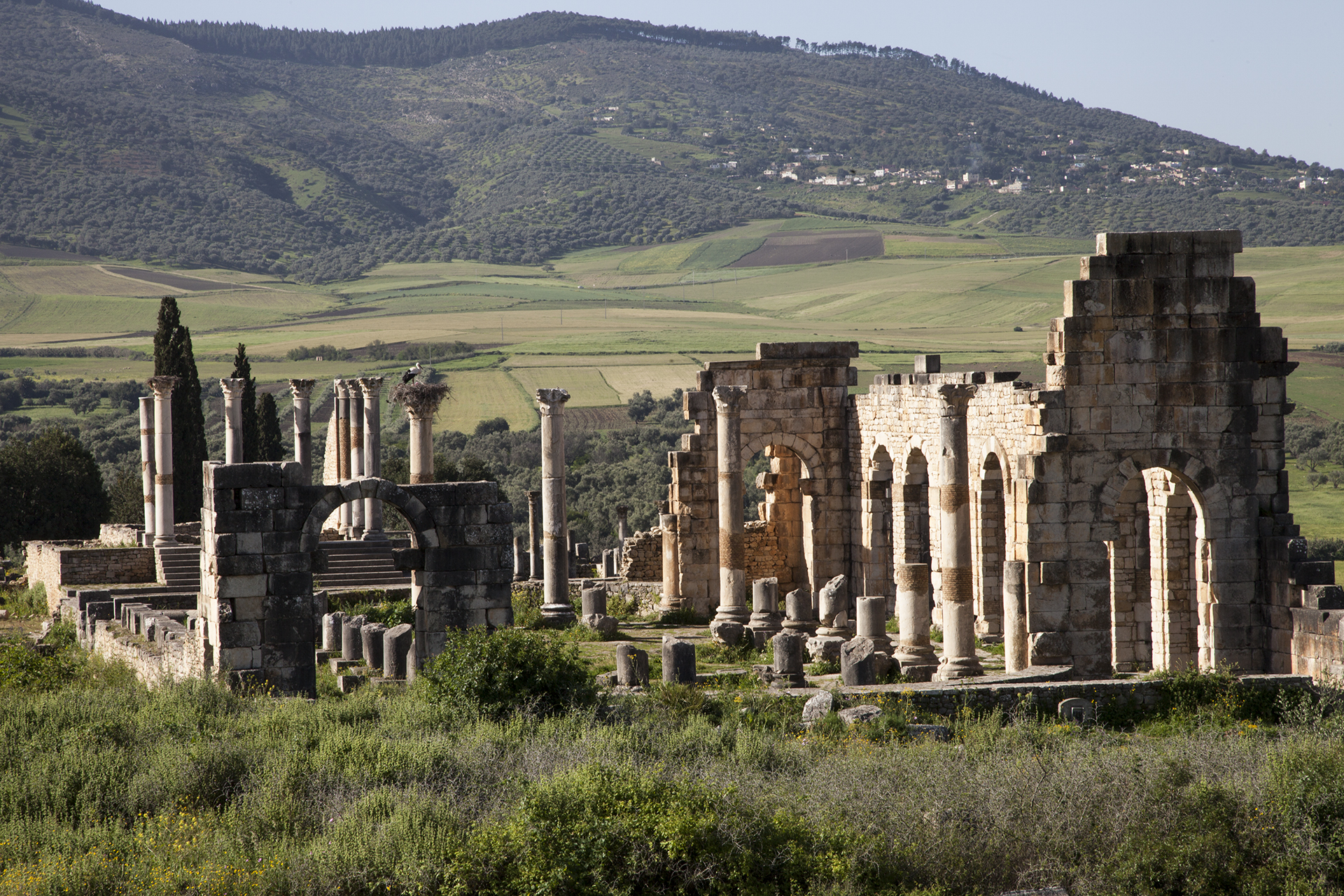
At its height during the Roman era, Volubilis covered an area of about 40 to 42 hectares and was surrounded by a wall approximately 2.6 kilometers long, punctuated by several towers and gates, the most remarkable being a triple-arched gate. Its economic prosperity relied mainly on olive cultivation and olive oil production, evidenced by the widespread presence of olive presses and their remains throughout the site.
Large public buildings reflecting Roman urban character were built in the city—such as the basilica (court), the governor’s residence, the Capitoline temple, and the triumphal arch, which became one of Volubilis’s most famous surviving monuments. The city also included upscale residential districts with spacious houses featuring mosaic floors depicting mythological, natural, and animal scenes, making Volubilis one of the major mosaic art centers in North Africa.
 |
| Volubilis, the Ancient Archaeological City |
Civilizational and Cultural Importance
Volubilis stands as a model of cultural convergence within a single space, where Amazigh, Phoenician, Carthaginian, Roman, and early Islamic influences succeeded one another, each leaving a distinct mark on the urban layout, social organization, and cultural life of the city. This blend makes the site a living testimony to the history of the western Mediterranean and to the dynamic exchanges between both shores of the sea over the centuries.
The site briefly served as a political capital under Idris I, linking it to the beginnings of the Islamic state in Morocco before the shift of power to Fez, after which Volubilis gradually declined and was eventually abandoned. Nevertheless, the ruins remained present in local memory, and their stones were reused in nearby constructions, emphasizing the continuity of their connection with the surrounding landscape.
 |
| Volubilis, the Ancient Archaeological City |
Volubilis Today: World Heritage and Tourism
UNESCO inscribed the archaeological site of Volubilis on the World Heritage List in 1997, recognizing its outstanding value in documenting the history of Morocco’s ancient civilizations and the relatively good preservation of many of its monuments. Moroccan authorities, in cooperation with international archaeological missions, continue excavation and restoration work to uncover further information about the city’s layout and everyday life in antiquity.
Today, Volubilis is one of the most important cultural tourism destinations in the Fes–Meknes region, attracting visitors with its mosaics, triumphal arch, and open landscapes overlooking olive groves. It is often included in itineraries that combine Meknes and Moulay Idriss Zerhoun. The site helps promote cultural tourism and highlight Morocco’s deep historical roots, while also serving as a living laboratory for archaeology students and researchers interested in the ancient history of North Africa.


